
Seal and insulate in one pass
Spray Foam Insulation in Erie, PA
The right foam for each surface in a snowbelt home.
- Free on-site estimates across Erie County
- Written quotes listing material, thickness and R-value area by area
- Leaks, moisture and wiring problems pointed out before anything gets covered
Foam Stops the Air That Batts Let Through
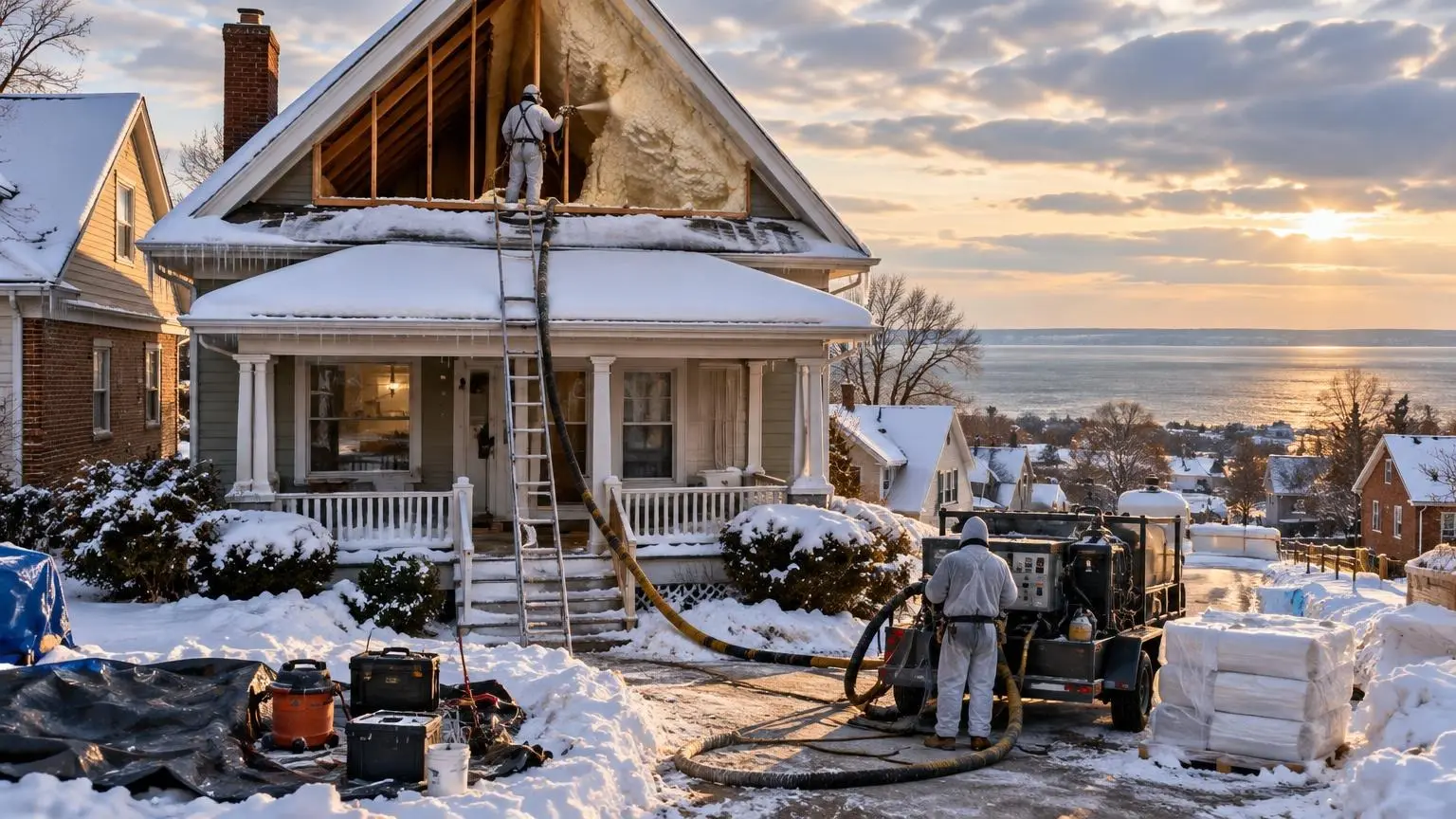
Spray foam insulation is mixed at the spray gun and expands as it goes on, filling cracks and bonding to wood, block and steel. That is the difference from fiberglass batts: foam stops air moving through the space it fills. In an Erie house, cold air sneaking in at the foundation and warm air escaping into the attic cause most of the discomfort and most of the ice dams, so foam is most valuable at the edges of the house where those leaks happen.
Open-cell foam
Open-cell is soft and light. It expands a great deal, so it fills irregular cavities and blocks air well. HomeGuide puts it at R-3.5 to R-3.7 per inch. Because it lets some water vapor pass, in a cold climate it goes where a vapor retarder is handled some other way, or in interior partitions and floors between heated rooms where sound is the concern. It costs less per square foot than closed-cell.
Closed-cell foam
Closed-cell is dense and hard, at R-5 to R-7 per inch. At a couple of inches it acts as a vapor retarder and does not take on water, which matters in the snowbelt. It is our usual pick for rim joists, block basement walls, crawl space walls, pole barn steel and roof decks where there is no room for vent channels. It also adds stiffness to the surface it bonds to.
Is foam right for your project?
Good signs: a basement that feels drafty at the sill, cold floors over a crawl space or garage, a finished attic room that is never comfortable, a steel building that drips in winter, or ice dams every year. A sign another product fits better: a big open attic floor, where loose fill reaches R-49 for much less once the leaks below it are sealed. Pennsylvania's code lists R-49 ceilings for Zone 5, and Erie County is in Zone 5A.
Timing in a snowbelt
Foam needs the surface and the material within a working temperature range. Basements and other heated spaces can be done any time. Unheated attics, crawl spaces and pole barns are easier outside the coldest stretches, so many Erie homeowners book in late summer and fall. We plan the date around the forecast.
Common Foam Jobs
Each one is listed separately on your quote.
Rim joists and sills
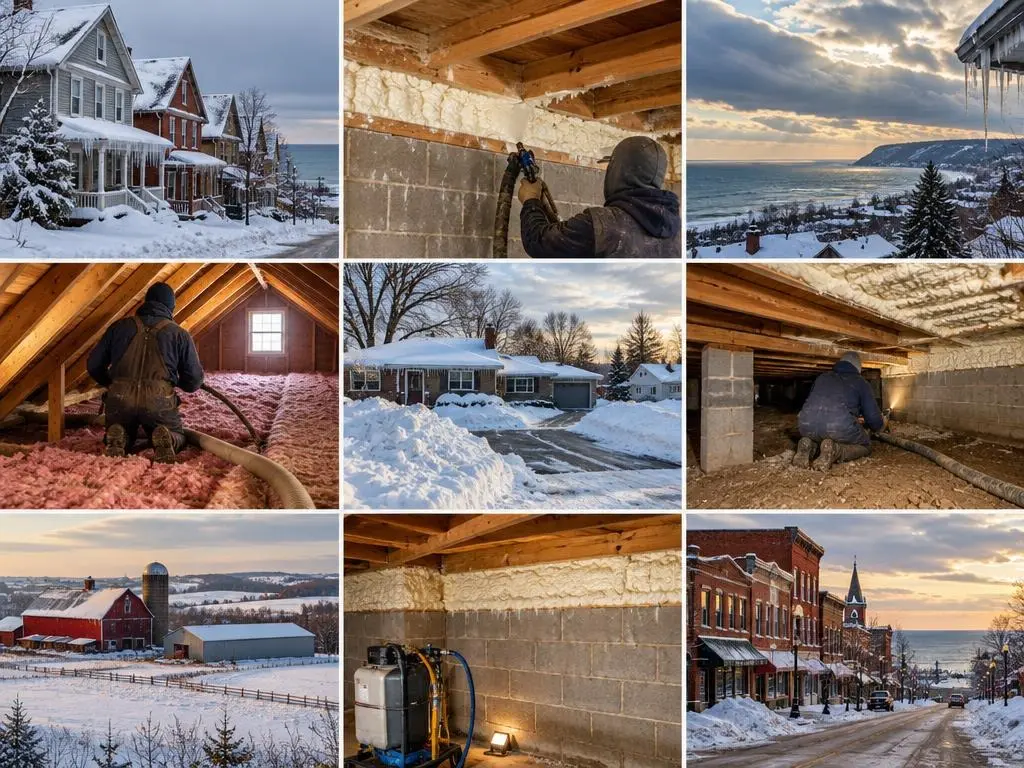
Closed-cell foam around the full perimeter of the basement, where the house meets the foundation.
Rooflines and finished attics
Foam under the roof deck for cathedral ceilings, attic rooms and kneewall spaces.
Crawl space walls
Closed-cell foam on crawl space walls under additions and older homes.
Pole barns and garages
Closed-cell foam on steel and framing to insulate and stop condensation drip.
Open walls in remodels
Foam in exposed stud bays during a kitchen, bath or addition project.
Published Spray Foam Costs
| Job | Published range (source) |
|---|---|
| Installed spray foam | $1.50 to $5.00 per sq ft (HomeGuide) |
| Open-cell / closed-cell | $1.50 to $3.50 / $3.00 to $5.00 per sq ft (HomeGuide) |
| About 1,000 sq ft | $1,500 to $5,000 (HomeGuide); $3,150 to $7,500 in an existing home (Fixr) |
| Existing walls / new construction | $3.15 to $7.50 / $2.75 to $6.50 per sq ft (Fixr) |
| Whole house | $8,000 to $20,000 (HomeGuide); $10,000 to $30,000 (Fixr) |
| Typical minimum charge | $1,000 to $2,000+ (HomeGuide) |
These ranges are national: HomeGuide's 2026 guide and Fixr's 2025 guide. Foam type, thickness, access and the time of year change the total in Erie. The price written on your estimate is what you pay.
How a Foam Job Runs
1. Inspect
Measure the spaces and check moisture, wiring and access.
2. Quote in writing
Foam type, thickness, R-value and price for each area.
3. Prep
Cover floors, mask surfaces, close off the area and set up ventilation.
4. Spray
Apply foam in passes to the planned thickness and trim where needed.
5. Re-entry
Clean up and tell you when to come back in; HomeGuide's guidance is at least 24 hours.

Why Choose Us for Spray Foam Insulation
Foam where it earns its cost
Loose fill is suggested where it does the job for less.
Thickness written down
So you can compare bids line by line.
Problems flagged first
Roof leaks, frost or damp sills are named before anything is covered.
Spray Foam Insulation Questions
Open or closed cell for an Erie basement?
Closed-cell, almost always. It slows vapor and does not absorb water, so it keeps damp basement air off cold block and wood.
Can spray foam be applied in winter?
In heated spaces, yes. Unheated attics and pole barns are harder in deep cold because foam needs a working temperature range. We schedule around the weather.
Does spray foam need covering?
In living spaces and many basements, foam has to be covered by a thermal barrier like drywall, unless a product rated for exposure is used. We explain this before you sign.
Who manufactures spray foam insulation?
Several national chemical companies make spray foam systems. What matters more for you is the type (open or closed cell), the thickness, and that it is installed to the maker's instructions, all of which we list on the quote.

Spray Foam Insulation Service Areas
- Spray Foam Insulation in Erie, PA
- Spray Foam Insulation in Millcreek Township, PA
- Spray Foam Insulation in Harborcreek Township, PA
- Spray Foam Insulation in Fairview Township, PA
- Spray Foam Insulation in Summit Township, PA
- Spray Foam Insulation in McKean Township, PA
- Spray Foam Insulation in Lawrence Park, PA
- Spray Foam Insulation in Girard, PA
- Spray Foam Insulation in North East, PA
- Spray Foam Insulation in Edinboro, PA
- Spray Foam Insulation in Waterford, PA
- Spray Foam Insulation in Union City, PA
- Spray Foam Insulation in Corry, PA
Get a Spray Foam Insulation Estimate
See where foam pays off in your house.